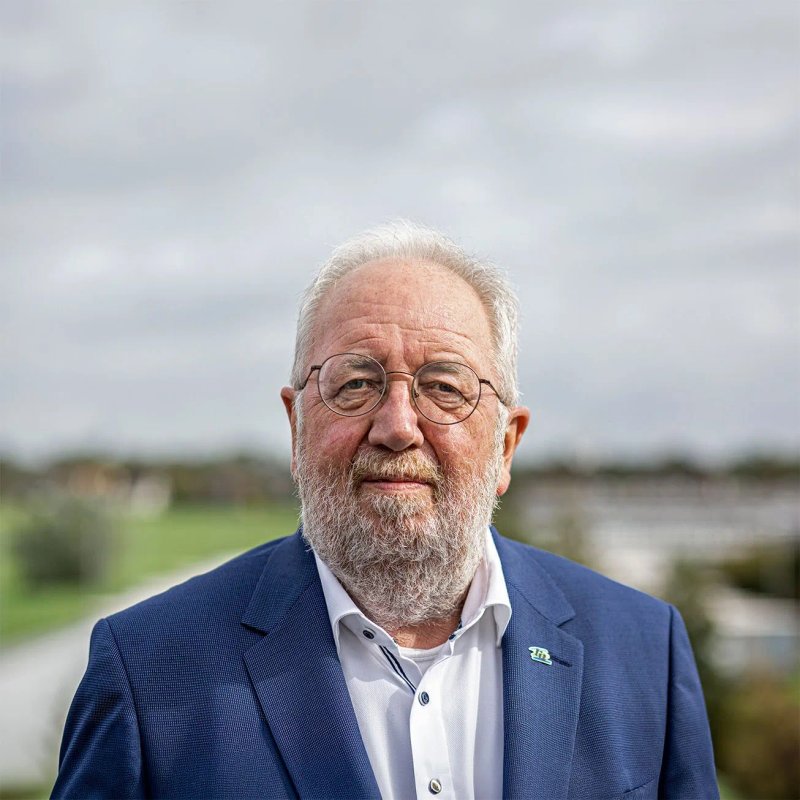
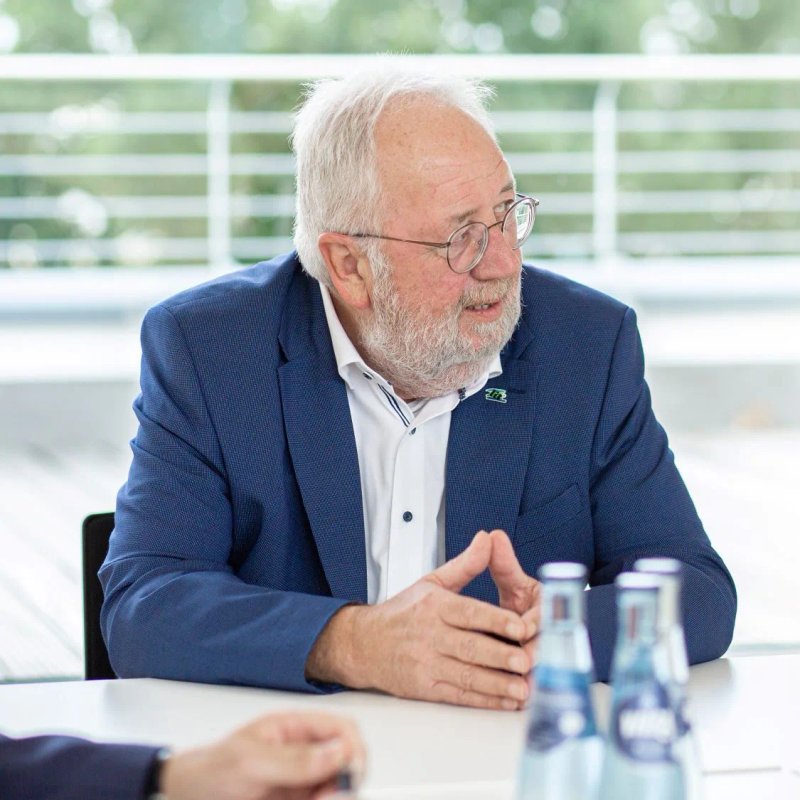
Chairman of the Board Fokke Fels in an interview with DVZ
For several years, LIT AG, based in Brake, has been on a strong growth trajectory. Chairman of the Board and owner Fokke Fels describes why and what else he plans to do.
Fokke Fels is the proverbial entrepreneur through and through. At 66 years old, he is not considering retirement. Instead, last year he extended his contract as Chairman of the Board of his LIT AG by another five years. In this role, he remains actively involved in the operational business – albeit not with the same intensity as before.
But why does he do this? “We are currently in an expansive phase. And I want to send a signal to the team that the captain is staying on board,” says the sole company owner, using a nautical metaphor.
For several years, LIT has been expanding vigorously. Unconsolidated revenue has more than doubled in the past five years, from 391 million Euros (2018) to 835 million Euros (2023). Even in the past year, which was truly not easy for the industry, LIT managed to grow by almost 100 million Euros, or 15 percent, against the trend. “2023 was a very good year for the group. We had good contracts and good capacity utilization,” Fels concludes. This year, a revenue of 930 million Euros is targeted, and in 2025, “we will probably reach 1 billion.”
How is this achieved? The basis of this development was a significant change in strategy in 2008: At that time, during the economic crisis triggered by the financial sector, LIT was very Automotive- and thus jumbo transport-heavy, Fels recalls. Approximately two-thirds of the business at that time was dependent on the automotive industry. “We wanted to move away from this dependency.” Today, the Automotive segment contributes only 20 percent to revenue. Furthermore, LIT adheres to the principle that no single customer should contribute more than 5 percent to the total revenue.
Various acquisitions, through which LIT has diversified in recent years, are responsible for a significant part of the growth. Companies such as Kieserling, Hölkemeier, Westfalia, a part of the Würfel-Gruppe, Fehrenkötter, and the Gübau-Gruppe belong to LIT. Fels emphasizes that all of them have developed very positively under the LIT umbrella. The acquisition of Kieserling in 2018 was a milestone, “it was the basis for our entry into Contract Logistics as well as the air and sea freight sector.” Cross-selling within the LIT-Gruppe has also contributed to growth.
Given Room for New Things
At the same time, the LIT owner “has given the team room to tackle new things and also to acquire completely new business.” An example: Kieserling Contract & Logistics in Northern Germany has been active for the online giant Amazon in last-mile delivery since 2019. Approximately 400 vehicles are now on the road for delivery at various Northern German Locations – all with company-owned personnel, as Fels emphasizes.
“We have accelerated growth in recent years and deliberately accepted a lower return,” Fels describes the approach. New businesses or new facilities typically cause start-up losses, “but existing businesses must be profitable.”
Thus, the EBIT margin in 2021 and 2022 was a modest 1.5 percent, based on unconsolidated revenue. However, in the future, profitability should be more central, states the LIT CEO. “We should aim for 3 to 4 percent,” a value the group achieved in 2023.
However, this does not mean that the group no longer wants to grow. On the contrary, “we do want to – organically and through acquisitions.” Today’s LIT size with approximately 4,000 employees “is sufficient for today and tomorrow, but will it still be sufficient in five years?” The LIT CEO is not sure. However, because he definitely wants to continue to operate as an independent player in the market, “we will have to grow,” is his conclusion.
Regarding acquisitions: The entrepreneur generally considers it possible to integrate up to three or four acquisitions annually. “I assume that we will finalize one or two more deals this year,” he announces. The focus will be on further strengthening the transport sector, but he also sees prospects in the specialized service area of Contract Logistics. However, he does not yet name potential acquisition targets.
Nevertheless, LIT does not pursue an active, targeted acquisition policy; “there is no list of 50 companies that we want to work through.” Instead, Fels is often approached by entrepreneurs looking for a long-term succession solution for their businesses.
As a rule, acquisitions also operate independently in the market after being taken over by LIT. Synergies are achieved in administration and purchasing, which is why Fels is looking at companies with their own fleet. These must be successful in their market segment and perceived as specialists there. And they must be profitable, not restructuring cases, that is the clear message.
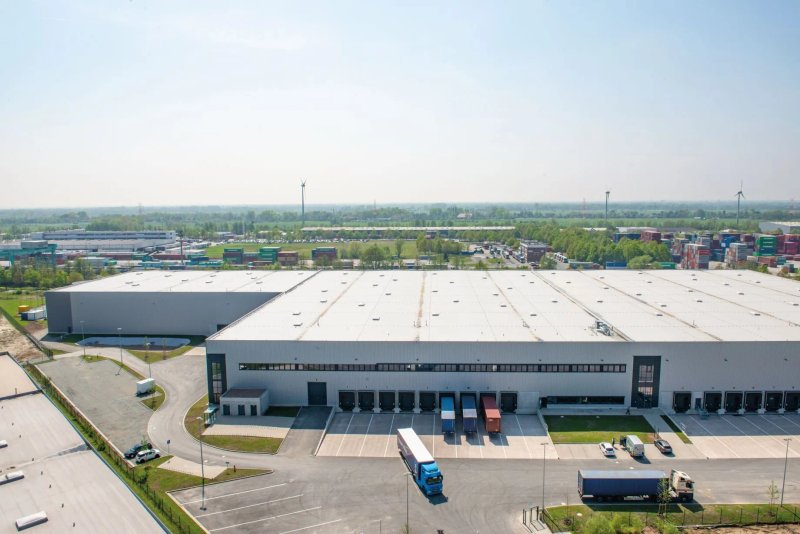
Contract Logistics is currently a key growth driver. This year, warehouse capacity is to be significantly increased again – from currently 850,000 to 950,000 square meters. In Minden alone, one of LIT’s key Contract Logistics Locations alongside Bremen and Germersheim, a facility with 45,000 square meters of space is being built for approximately 30 million Euros.
In addition, in 2022, the subsidiary Automotive Solutions was founded specifically for customers from the automotive industry who have a special requirement profile in Contract Logistics. In this segment, LIT plans to grow strongly given the decreasing number of players in this market, Fels plans.
Furthermore, LIT is significantly expanding its involvement in the sea and air freight business in the coming months. The company is increasing its global presence. Fels announces that a new company is being founded in Singapore these days, which will act as a holding for LIT’s overseas offices. In addition, its own office in Istanbul will open at the end of May, and a branch in Shenzhen, China, is planned a few weeks later. A 50 percent stake in a Korean company is foreseen in Busan. “We are in the final discussions there,” he indicates. Further engagements are planned in Bangalore (India), the USA, Vietnam, and Mexico. Already next year, the revenue of this LIT division is to be doubled from 22 million Euros in 2023 to 50 million.
The AG (public limited company) functions as a platform for the 70 LIT companies operating in the market, typically with between 50 and 150 employees. Each is managed by one person. According to this basic principle, the acquired companies also continue to operate independently in the market. From the headquarters in Brake, approximately 200 employees primarily manage administration; the board itself is also based there.
In addition to the easier manageability of the operational business, this structure has another advantage: “We are not perceived as a conglomerate, but rather as what we are – a large mid-sized company. And I firmly believe that a mid-sized company, with appropriate performance, is preferred by many customers due to its personal approach,” says Fels. He emphasizes that even large customers – names such as Daimler, Knauf, Unilever, Melitta, or Mars are on the reference list – value personal contacts and continuity. “Logistics, despite all digitalization and automation, is still a people’s business.”
Advantage for the Climate – and for Colleagues
An important future topic for the company is mastering digital transformation. Resources are to be expanded accordingly. The ‘I’ in the company name has always stood for Information – the company has developed all essential IT solutions itself, Fels proudly states. Therefore, he considers this area and the great openness to process solutions as important unique selling propositions of the group. The subsidiary Comlogis is responsible for this. The ‘L’ stands for Logistics, by the way, and the ‘T’ for Transport.
Furthermore, Fels wants to further expand combined transport. For years, LIT has operated the joint venture Smartrail Logistics together with the rail logistics provider Captrain Deutschland to link trucks and freight railways. Smartrail thus markets three weekly trains from Dresden to Emden with supplier parts for the VW plant there. “The combined transport market in Germany and Europe is currently reorganizing itself, and we want to be involved,” Fels emphasizes.
Even though the childless LIT executive wants to remain on board until the end of 2028 – what are the succession plans? LIT should remain independent in any case, that is his wish. Therefore, a foundation is to take over the shareholder role, on the establishment of which Fels and his wife Anke Hollmann are currently working intensively. But his retirement is still some time away anyway.
LIT at a Glance
- The company was founded in 1988 by Fokke Fels, Dieter Lauschke, and Roland Schiefke. Lauschke was replaced shortly thereafter by Christian Niemann. Fels has been the sole owner since 2014.
- LIT AG functions as a holding company; approximately 70 independent companies operate under it, grouped into five organizational units: LIT Speditions GmbH, LIT Cargo GmbH (drivers and fleet), LIT Lager & Logistik (Contract Logistics), LIT Personalmanagement, and Comlogis (IT).
- LIT employs over 4,000 people (including 1,300 drivers) at 101 Locations in 14 countries; approximately 400 (90 drivers) of them work abroad.
- Revenue 2023: 835 million Euros
- Fleet: 1,500 trucks, 5,400 swap bodies, 1,480 semi-trailers
- 850,000 square meters of logistics space at 45 Locations in Germany
- Most important business areas: Automotive, building and insulation materials, DIY store logistics, consumer goods, retail, Healthcare, industry/chemicals, paper, plastic, glass, and packaging industry
- Subsidiaries operate independently in the market under the umbrella of LIT AG.