
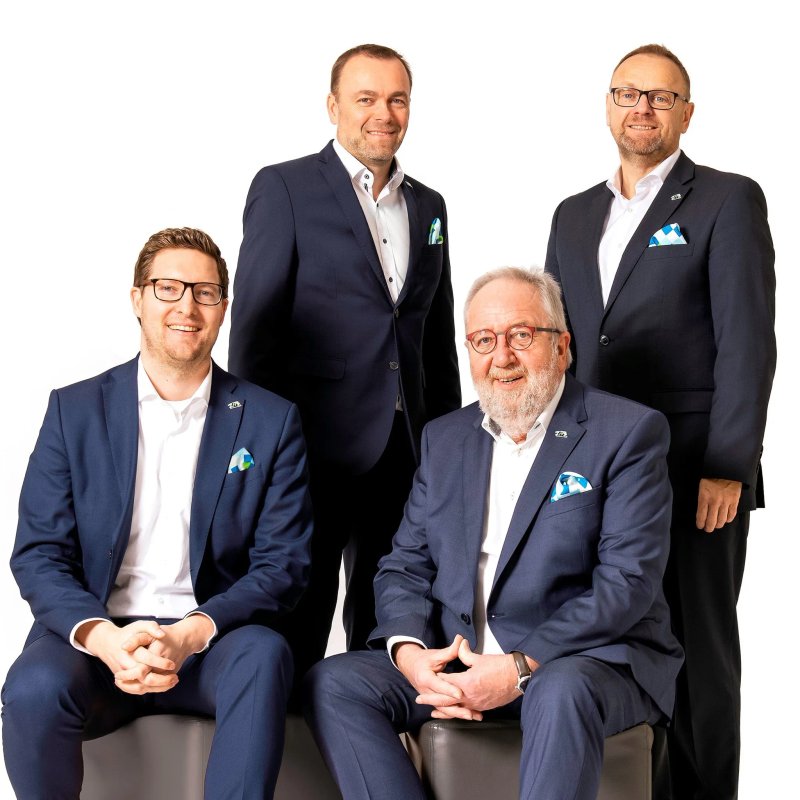
The L.I.T. Executive Board in an interview: on the challenges and goals of the corporate group
The year 2022 was marked by crises. L.I.T. proved resilient and set crucial courses. For the current issue of L.I.T.eratur, we asked our Executive Board how the corporate group is addressing the challenges and how important its international orientation will become.
Looking back from an entrepreneurial perspective: How was the year 2022?
Fokke Fels: If we use the uncertainties and closures due to the Corona pandemic as a comparison, then it was better than 2021. Although the virus still accompanied us in our daily work, for example, no more factories had to be closed at our customers' sites. That was positive. However, the next crisis followed in February, the war in Ukraine. No one could imagine that one country in Europe would attack another. But we were taught otherwise – unfortunately. And the war of aggression also has indirect effects on us.
You are referring, among other things, to inflation, diesel prices, and lockdowns.
Simeon Breuer: Diesel prices already rose last year, but Russia's war of aggression massively fueled this development once again. At times, we had to pay more than two euros per liter. This is an enormous cost factor for our transport business, and it required massive efforts from all employees to develop solutions with our existing customers. Together with them, we found agreements. We would like to express our gratitude at this point – without them, we would not have been able to cope with this price explosion.
Ingo Schreiber: The driver situation among our Polish colleagues has also worsened this year. Almost a third of their truck drivers come from non-EU countries. The majority are people from Ukraine who have been conscripted since the war and are defending their country. This means more than 100,000 drivers are missing – which exacerbates the already high shortage of skilled workers.
In addition, there are delivery difficulties for towing and towed equipment; here we wait up to a year after ordering, and the availability of spare parts for repairs has worsened.
Air & Sea has developed positively; what new developments are there in this area, Mr. Breuer?
Breuer: We have, for example, opened up a rail connection via the "Iron Silk Road" to and from China with our L.I.T. Air & Sea GmbH in Hamburg. Although the transports take slightly longer, they are more reliable. Air & Sea is a real highlight and a true success story for us. After expanding to Barcelona in 2020, we opened two new Locations in Hamburg this year to handle air and sea freight transports more specifically from there. The company's development in recent years is more than gratifying. We are optimally positioned for the future.
Despite the crises you have already mentioned, L.I.T. is also growing this year. Why are you so crisis-proof?
Julian Lachnitt: We are resilient. For years, we have broadly diversified our company to avoid being dependent on a single industry or service. This extensive portfolio prevents us from getting into difficulties during crises, such as missing semiconductors and wiring harnesses, cancelled shifts, or scarce raw materials.
Internationalization now plays an even more important role for L.I.T. As an example, international customers such as Miss Mary of Sweden and Palfinger AG have been acquired as projects.
Fels: Our international orientation and our size definitely help us with such exciting projects. Both companies – Miss Mary from Estonia and Palfinger from Austria – were looking for a suitable and individual logistics solution for the German and international market. We were able to convince them with our concepts and are delighted with both projects.
Breuer: However, we do not only implement comprehensive logistics solutions in Germany for international customers. In total, we are represented with 101 Locations in 14 European countries and implement logistics concepts. This year, we founded a new company, L.I.T. Cargo CZ Sro., in the Czech Republic. We see this as an opportunity to create new resources and capacities in the fleet for even greater efficiency in the forwarding business.
Schreiber: And above all, to improve the situation regarding driver availability. We previously relied on external partners and are now increasingly covering this with our own drivers. In the middle of the year, the first trucks under the L.I.T. flag with Czech license plates left the yard. Overall, we are very satisfied with the start.
What is the reason for internationalization?
Breuer: We want to offer our customers comprehensive transport services in Europe. Therefore, next year we will open a Location in Lithuania and expand the product portfolio of L.I.T. Air & Sea in Barcelona to include land transports. Both were previously "white spots" on our European map, which we are now successively closing to offer our customers exactly the logistics concept they need.
Are there any other "white spots" in Europe?
Breuer: When we consider international expansion, we primarily focus on countries like Slovakia. We are already represented in Central Eastern Europe, but countries like Hungary or Slovakia are very interesting markets. They are emerging nations.
However, you have also invested in existing international Locations. For example, the workforce in the Netherlands received a new office this year. In Zielona Góra, Poland, a new innovative building was already invested in three years ago.
Lachnitt: The new Locations in the Netherlands and Poland are clearly linked to our growth. Both companies had reached their capacity limits, so we had to and wanted to react. Administratively, we keep processes lean to ensure scalability. If, for example, these Locations develop even better, we can react quickly.
Breuer: We do the same with L.I.T. Ceska republika s.r.o. This also makes us resilient again, to bring it back to the beginning. Through such building blocks, we can distribute our business even better and position ourselves to be crisis-proof.
"Building blocks" is a good keyword: Despite the crises, you have incorporated two new companies into the corporate group this year.
Schreiber: Correct, however, both projects must be differentiated. In combination with WESTFALIA intralog GmbH, the acquisition of Würfel Spedition GmbH was a logical step. This allows us to achieve even stronger market penetration, as Würfel and WESTFALIA serve the same business. Thanks to the acquisition, we now have over 4,500 swap bodies, making us a big player in this field. With the acquisition of Fehrenkötter Transport & Logistik from Ladbergen, we have integrated a new building block. Now we can offer something we could not before. In addition to agricultural machinery transports, we are the first transport service provider to offer both inbound and outbound logistics from a single source for vehicle manufacturers.
Fels: Furthermore, we are focusing even more strongly on Contract Logistics and want to position ourselves in the market. Projects such as those with Miss Mary of Sweden and Palfinger AG contribute optimally to our goals. In addition, we have founded Automotive Solutions GmbH, with which we offer and successfully implement logistics solutions for OEMs.
How do you view the coming year?
Fels: I am optimistic about the coming years because we have done our homework. With the founding of L.I.T. Solutions GmbH with Klaas Lange as Managing Director, we have further professionalized ourselves in project management and are perfectly positioned for the future. This is a real milestone. Certainly, driver availability will remain a major issue that we, as the L.I.T. Gruppe, will also address. We want to continue to be a secure employer for our colleagues and offer an attractive workplace. We have been successful in this for many years, and I notice that the cooperation is trusting and collegial. True to our company motto "Together for Success," we want to meet the impending challenges and successfully master our projects in the coming year.