
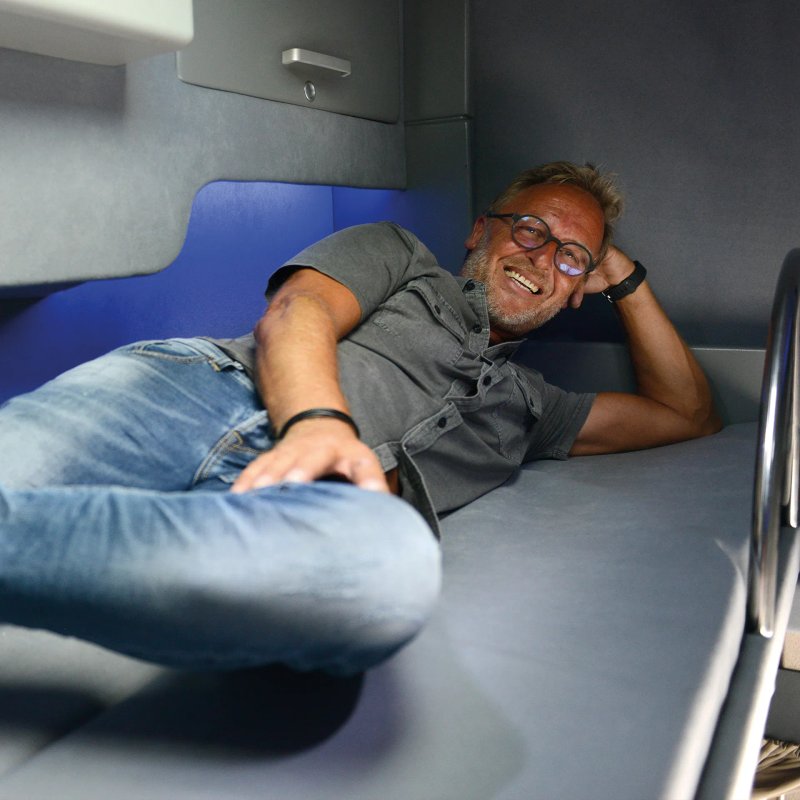
INTERVIEW WITH ARWED BUTTERWECK | BRANCH MANAGER IN BAUNATAL
INNOVATIVE SLEEPINGL.I.T. develops a roof sleeper cab for ultralight trucks with the patent-protected Efficiency CAB

We wanted to create a modern workplace for our drivers with maximum space, without having to accept compromises in loading capacities or truck efficiency. It was important to us that despite the efficient and space-saving design, the highest possible comfort for male and female drivers is provided. Neither with our previously used roof sleeper cabs nor with those currently available on the market could we find solutions that met our quality and spatial requirements. The decision for an in-house construction, especially for the interior, was therefore obvious and quickly met with great approval within the L.I.T. Gruppe.

The development team consisted of Willi Kemmnitz from Orten Fahrzeugbau GmbH, technicians from Gniotpol Trailers Sp.o.o., and myself from L.I.T. Cargo GmbH. Spojkar from Poland supplied the roof construction and was also responsible for the interior fitting. Only through a collaborative and close partnership was it possible to achieve the optimum. To ensure everyday usability, we involved and integrated approximately 200 drivers. After all, they are the ones who will ultimately sleep in the Efficiency Cab and benefit from its comfort. Their wishes and suggestions were immensely important to us and therefore decisive for the final product.

How long did the development take and what practical tests had to be carried out?
The Efficiency CAB is precisely tailored to the MAN TGL 8.220 4×2, model year 2017. Seven months passed from planning to initial delivery. During this time, numerous adjustments, load, and strength tests were carried out. Our main focus was on ensuring that our drivers feel comfortable. They often spend several days at a time in the truck. The cab is then their living room and should meet individual requirements as much as possible. In the discussions, it became clear that good lighting conditions and the largest possible storage space are particularly important in everyday life. A lot of light should be able to enter the cab, but it should also be very well insulated for summer and winter and include a parking air conditioning system. Good ambient lighting and a ventilation system were also among the requirements.

What specifications, such as safety standards and technical conditions of the MAN TGL 8.220 4×2, model year 2017, had to be considered during development?
Almost all of them: Starting with the roof cutout, the strength of the cab, the modification of the cab mounting, the conversion of the cab suspension to air suspension, the subsequent certification, and the creation of the expert report according to the guidelines.
The difficulty with ultralight vehicles is that they have a very small cab. Finding a spacious and high-quality equipped solution without having to compromise on loading capacity presented the entire development team with several problems. Weight, dimensions, interior fitting, insulation, the creation of a new mono-form, etc. – that was a really big challenge in the development.

What are the special advantages of the Efficiency CAB compared to earlier roof sleeper cabs?